I went to a week long group therapy retreat this summer because I'm CrAZy and I found out what my drug of choice is: Isolation. I'm an INFP according to the priests of Jungianism, the "I" meaning introvert. Yet I find being alone very painful.
The negative effects of Isolation are pretty self-evident, but here's an article on the physiological effects of it on the brain:
So introversion may be a legitimate proclivity, but I think there's a distinction between going home to "re-charge" and going home to "freak the fuck out," the latter of which is my favorite pass time. When feeling stressed, which I feel VERY OFTEN, I don't tend to seek the company of other human beings to talk about it, process the emotions, or even just distract myself for a while. This might be because, as my personality visualization to the right shows, my purple "Emotional Stability Petal" is muy pequeno.
So why do I do things that stress me out? Well, an important thing I learned at the retreat I went to is that stress is a choice. It is a way of not actually processing what is happening around you or in you. Any sort of stimulant has the same effect. Some people snort cocaine, some down diet pills, while I, being the ingenious mind that I am, figured out how to get high without spending money -- just being by myself.
Stress is clinically defined as an inherently negative element of consciousness, while "Eu-stress" (Good-stress) is the term for any positive and motivating forces. Stress, as we know it today, is thought to be the effect of misfirings of the primitive "Flight or fight" mechanism of the brain. Sixpak Chopra goes into that a bit here. What leads to this misfiring?
Though Cousin Vivi viewed most of traditional Hinduism's exoteric tenants as helpful myths, but not facts in themselves, he did seem to cling to reincarnation as an explanation for why people feel, to different degrees, isolated. Some people are totally selfish, unenlightened, and seek their own ends -- usually to their misery in later life. Others seem completely connected and selfless and help move the world upwards with childlike purity. Why some and not others? The story is that the "more enlightened" have just been born more times, they've been "doin' it for a while."
This is hard pill to swallow, and it does seem like its suppressing some deeper truth. And since this truth is deeper, it must be truer, more empowering, and more beautiful than any myth. I know Plato would disagree, but he was into musical censorship, so fuck that guy.
One of the most profound spiritual realizations in the past millennium may be this: the sense of isolation is caused by trauma, in this lifetime.
Eckhart Tolle talks about "Pain Bodies" in his book A New Earth. In addition to our physical bodies, Tolle talks about conceptual "pain bodies" that follows us around in our lives, reacting negatively to stimuli in unwarranted situations. Actually Tolle considers this less "conceptual" than I do, in his presentation they are quite literally spiritual bodies, perhaps existing on a different "frequency" than observable material bodies.
The pain in our "pain bodies" is unprocessed trauma, suppressed somewhere and squirming its way out when we least want it. Whether you believe it is stored in your memories, in your physical body (i.e. in chronic sore muscles), or in a spiritual "pain body," a small amount of self-reflection reveals that unprocessed trauma does not leave us.
Tolle alludes to the idea that pain from before you were born can affect you now. I know people who interpret a lot of their pain as coming from "past lives," it's not just weirdos like Laura Dern in "The Master."
I don't actually have any direct problem with this hypothesis, besides the fact that I think its untrue. The indirect problem, that seems more troubling to me, is that believing in "past life trauma" might just a way to not fully process trauma. The pain emerges from your unconscious as a vivid image of something happening to you during the french revolution and you're like "woah, that explains my aversion to hairy men!" I'm skeptical of this because it's precisely the way that dreams hide truths, through metaphor. But this is some meta level griping I'm making and I'll get back to the point.
When we don't process traumas after they happen, there are physiological effects in our brain.
There was a demonstration at the retreat I went to this summer that went something like this:

 What's going to happen is your Amygdala, or "Hind-Brain" way down in the center of your grey stuffs, is going to fire dopamine to produce a rapid action. They call this the Flight or Fight response, or more expansively, the four F's: Fight, Flight, Fuck and Freeze. These are the four primitive survival behaviors that all sentient beings seem to be hardwired for. They even call the Amygdala the "reptilian brain" cuz' its so basic.
The Amygdala is hardwired to the "Mid-Brain" which is the emotional processing center of the brain.
The Mid-Brain and the Amygdala are extremely well connected. Dopamine fires up emotions which stir you towards certain desires and actions, all before you even have a chance to think. And I mean that quite literally, the Fight or Flight mechanism is meant to bypass any critical thinking skills for the sake of survival. These more advanced cognitive processes don't even exist in things like reptiles, so questions like "why should I hide from the bear?" or "what is the form of bear" don't occur to animals in the wild, and for good reason.
The problem is when this Amygdala based Dopamine reaction occurs for too long, then the Mid-Brain stops communicating with those advanced cognitive processes, which take place in the "Fore-Brain." This is the effect of "prolonged trauma," which can be anything from physical child abuse, to living in perpetual poverty, being raised with only one parent and missing the other's affection, all kinds of stuff. The important thing to know is it is not necessarily physical trauma. Emotional trauma has the same neurological effect as being in war, though to a different degree of intensity. But if you go years in an emotionally hostile environment, the neurological difference between that home and a tour in Baghdad is nil.
Research has show that if car accident victims are asked to tell the story of what just happened, they are less likely to suffer post traumatic stress disorder from the event in the future. This helps the brain fully integrate itself and allows you to process things in real time, and not slowly and accidentally over the years. This real time processing is, unfortunately, not the norm for some of us when it comes to dealing with traumatic events.
So, you didn't "talk it out," and a disconnect occurs between your Mid-Brain and your Fore-Brain (or Prefrontal Cortex). You get one of two outcomes:
1) Your higher level cognitive functioning is starved and your critical thinking becomes near impossible.
An episode of This American Life and Paul Tough's book "How Children Succeed" feature interviews with a psychologist who realized the implications of this. Underprivledged children score worse on critical thinking tests because their brains have been wired for survival and not for calculus, or philosophy. She says of the experience: "it was like that scene in The Matrix when Neo suddenly understands everything about the world." I think she really may be on to something there.
All that kinda makes me feel like shit because I'm not an underprivileged child, but I do have tremendous emotional fluctuations, and I'm very good at critical thinking! What gives? Well, there's another way your brain can react to prolonged trauma:
2) Excessive intellectualizing and neuroticism.
Think about it. Ideally your brain connects all three parts and they work as a team. The physiological designation of the Hind, Mid, and Fore-Brain have been linked with concepts like the Id, Ego, and Superego. They're best when they're all pulling their weight. But what does a malfunctioning brain look like?
I find that these physical parts of the brain are easily connected to Plato's three designations of the parts of the soul: Spiritedness, Desire, and Reason. Neurotic intellectualism can be understood neurologically as the Fore-Brain being fully detached from the Mid and Hind-Brain. Anyone who's been a sensitive soul inside the world of academia know that underneath the placid facade of "put-togetherness" there's a tremendous amount of emotional and existential angst on every campus.
You can view society as basically divided along the lines of the question: "in what way have you learned to suppress trauma?"
So Plato noticed that there was a conflict going on inside everyone's soul. People have referred to him and Socrates as the first Psychiatrists. What was Socrates' solution?
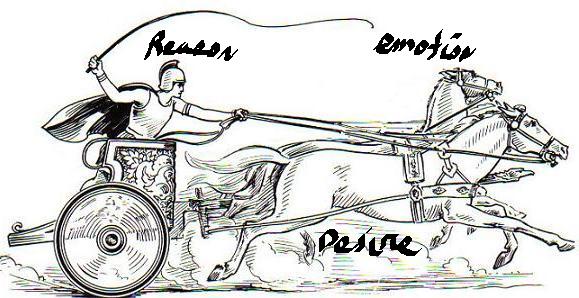
 Here's Socrates' image from the "Phaedrus", reason whips the Desires (Mid-Brain) and the Emotions (Hind-Brain) into shape. What does this mean in practice? In the Republic Socrates has lengthy passages where he hashes out how the leaders of the perfect city, known as "The Guardians," will order their souls. Since Socrates believes that disordered minds are the result of past trauma, he has the guardians process the painful events of their past, which are keeping them from perfect wisdom. He describes several exercises where one guardian pretends to be your mom, another your creepy uncle, and you finally get to say all those things you never got to. There's another activity one where you simply let thoughts and feelings arise and leave, not trying to disturb them or label them, just letting them integrate into your consciousness and then pass away. In this way harmony develops between the three formally warring parts of the brain. And since the Republic is a model for the perfect soul and the perfect city, this is how universal peace is possible!
Just kidding! That wasn't how what Socrates did. I was describing a mix of Buddhism and modern Experiential Psycho-Therapy. The Republic is a description of a very aggressive Prefrontal Cortex doing everything it can to control the other parts of the brain. Socrates identifies memebers of society who correspond to different aspects of the mind and says that they need to be controlled, lied to, oppressed or even ejected from the city for the sake of its survival. Even music that stirs up the wrong part of the soul must be banned! How fun this guy must have been! DYK The Preacher from "Footlose" was a Philosopher King? The end result is the tyranny of raw "reason" over the other aspects of consciousness, to the extent that the most common and unifying feelings of compassion and love seem to be absent from "the True Philosopher."
Perhaps this is the ideal of a Western Philosopher and maybe this is what "Ego-death" is in the East. Maybe its a necessary phase we all must go through. But it is not the ideal state of being for men like The Wizard Tolle, however. When you realize that this "enlightenment" is merely the mismanagement of trauma, it becomes a lot less appealing. And it always reveals itself to be unstable.
Some thoughts to swallow: The first word of The Republic is "κατέβην" or "I went down." Socrates bans flute playing from the city. The poets in Plato's time had a euphemism for oral sex: "Playing the flute."
But if the Platonic path is the path to peaceful, living on the island of the Blessed, and not a systematized process of denial, lets look at Plato's life and see how peaceful it was. Plato's Seventh Letter, the last thing he is known to have written, does not reveal a passionless, carefree soul. Heading towards his death, Plato is seen to be a crotchety, frequently kidnapped vagabond who wont rest for a moment until he can get someone in power to establish the perfect city (under his guidance). There's lines in it that could probably translated to quite literally say: "I'm too old for this shit!" And the worst part is he's trying to get everyone's attention, anyone who will listen, to how he has it all figured out if only they'd listen! "They, they, they." It's all about what's wrong with other people for the Pre-Frontal Cortex guys. Let's check in with Rev. G-Unit:
Stress, in my neurotic Liberal Artsy way, is spending most of my time in my Pre-Frontal Cortex. Alone, I can let all my fears about the world and concerns about what everyone else is doing flow all over me. "If they'd stop being so fucked up, I'd be at peace!" I'm isolated from others, and isolated from my feelings by this strong psychic barrier -- but in the abject panic of "being alone in this world," just enough existential angst gets stirred up that I can get high, and ignore whatever is down there that actually needs to express itself.
How do I integrate, instead of dissociate? How do you just "Feel your feelings"? There's an Eva Brann book by the name: Feeling our Feelings: What Philosophers Think and People Know, but I don't think more books are the answer for me.
The negative effects of Isolation are pretty self-evident, but here's an article on the physiological effects of it on the brain:
For decades now, researchers have tracked the effects of loneliness and isolation on our physical health. One study with mice subjects found that isolation could increase cancerous tumor growth [source: University of Chicago Medical Center]. Another study found that isolation is a risk factor for disease on par with smoking and obesity [source: Goleman]. Loneliness often leads to stress, which is a risk factor for many conditions in its own right.
 |
| Flower un-empowered. |
The relationship between my other petals and the purple one is something like the relationship between:


and:


Its really the big ones that make all the great times happen. They kinda have "a good thing going." The little purple one does get some laughs when he freaks out about stuff, but a lot of the humor just comes from him being so small. If I could have my way, I'd write the purple midget off the show entirely.
I met the guy who played the little person on Seinfeld, Danny Woodburn, this summer. I was an assistant on a movie he was in. I was called on to set (I was trying to spend the day alone at home isolating ironically enough), and the head P.A. asked if I'd be Danny's stand in. I'm 5'4'', a good 16 inches taller than Mr. Woodburn, but I guess I slouch a lot. I'll blame my purple petal for that. We shook hands and said hello only briefly, he had kinda sparkly eyes!
So why do I do things that stress me out? Well, an important thing I learned at the retreat I went to is that stress is a choice. It is a way of not actually processing what is happening around you or in you. Any sort of stimulant has the same effect. Some people snort cocaine, some down diet pills, while I, being the ingenious mind that I am, figured out how to get high without spending money -- just being by myself.
 |
| "Who asked you to be in charge, Michael?" |
Sixpak explains:
Not everyone is equally vulnerable to stress. Genetics play a role in how a person's body reacts. Your past experiences can affect your response, too. If you lived through a lot of stressful situations growing up, you may be more sensitive to stress as an adult.I think hard facts like this are a healthy addition to my blog/life. There is something very fun and empowering and mysterious about talking about "God-consciousness" and all that, but without a grounding in physiology, and one's personal history, and really in reality, all those "mystical" pursuits will be unstable and even dangerous. But even Cousin Vivi seemed stumped by the question: "If we are actually always in connection with God and the ground of Being, why do we ever feel separated? Why do we buy into the illusion of otherness?"
Though Cousin Vivi viewed most of traditional Hinduism's exoteric tenants as helpful myths, but not facts in themselves, he did seem to cling to reincarnation as an explanation for why people feel, to different degrees, isolated. Some people are totally selfish, unenlightened, and seek their own ends -- usually to their misery in later life. Others seem completely connected and selfless and help move the world upwards with childlike purity. Why some and not others? The story is that the "more enlightened" have just been born more times, they've been "doin' it for a while."
This is hard pill to swallow, and it does seem like its suppressing some deeper truth. And since this truth is deeper, it must be truer, more empowering, and more beautiful than any myth. I know Plato would disagree, but he was into musical censorship, so fuck that guy.
One of the most profound spiritual realizations in the past millennium may be this: the sense of isolation is caused by trauma, in this lifetime.
 |
| In the 3rd book Tolle is revealed to be a werewolf. |
The pain in our "pain bodies" is unprocessed trauma, suppressed somewhere and squirming its way out when we least want it. Whether you believe it is stored in your memories, in your physical body (i.e. in chronic sore muscles), or in a spiritual "pain body," a small amount of self-reflection reveals that unprocessed trauma does not leave us.
Tolle alludes to the idea that pain from before you were born can affect you now. I know people who interpret a lot of their pain as coming from "past lives," it's not just weirdos like Laura Dern in "The Master."
 |
| "This sounds wacky, but I feel like in a future life I'm going to be chased by Dinosaurs..." |
When we don't process traumas after they happen, there are physiological effects in our brain.
There was a demonstration at the retreat I went to this summer that went something like this:
So you're having a trauma.

The Amygdala is hardwired to the "Mid-Brain" which is the emotional processing center of the brain.
 | |
| These are the worst drawings ever. |
The Mid-Brain and the Amygdala are extremely well connected. Dopamine fires up emotions which stir you towards certain desires and actions, all before you even have a chance to think. And I mean that quite literally, the Fight or Flight mechanism is meant to bypass any critical thinking skills for the sake of survival. These more advanced cognitive processes don't even exist in things like reptiles, so questions like "why should I hide from the bear?" or "what is the form of bear" don't occur to animals in the wild, and for good reason.
The problem is when this Amygdala based Dopamine reaction occurs for too long, then the Mid-Brain stops communicating with those advanced cognitive processes, which take place in the "Fore-Brain." This is the effect of "prolonged trauma," which can be anything from physical child abuse, to living in perpetual poverty, being raised with only one parent and missing the other's affection, all kinds of stuff. The important thing to know is it is not necessarily physical trauma. Emotional trauma has the same neurological effect as being in war, though to a different degree of intensity. But if you go years in an emotionally hostile environment, the neurological difference between that home and a tour in Baghdad is nil.
Research has show that if car accident victims are asked to tell the story of what just happened, they are less likely to suffer post traumatic stress disorder from the event in the future. This helps the brain fully integrate itself and allows you to process things in real time, and not slowly and accidentally over the years. This real time processing is, unfortunately, not the norm for some of us when it comes to dealing with traumatic events.
 | ||
| I chill with this dude way too often. |
1) Your higher level cognitive functioning is starved and your critical thinking becomes near impossible.
An episode of This American Life and Paul Tough's book "How Children Succeed" feature interviews with a psychologist who realized the implications of this. Underprivledged children score worse on critical thinking tests because their brains have been wired for survival and not for calculus, or philosophy. She says of the experience: "it was like that scene in The Matrix when Neo suddenly understands everything about the world." I think she really may be on to something there.
 |
| If adolescent Pre-Frontal Cortexes didn't shut down like this we'd never have The Wire! |
2) Excessive intellectualizing and neuroticism.
Think about it. Ideally your brain connects all three parts and they work as a team. The physiological designation of the Hind, Mid, and Fore-Brain have been linked with concepts like the Id, Ego, and Superego. They're best when they're all pulling their weight. But what does a malfunctioning brain look like?
I find that these physical parts of the brain are easily connected to Plato's three designations of the parts of the soul: Spiritedness, Desire, and Reason. Neurotic intellectualism can be understood neurologically as the Fore-Brain being fully detached from the Mid and Hind-Brain. Anyone who's been a sensitive soul inside the world of academia know that underneath the placid facade of "put-togetherness" there's a tremendous amount of emotional and existential angst on every campus.
You can view society as basically divided along the lines of the question: "in what way have you learned to suppress trauma?"
So Plato noticed that there was a conflict going on inside everyone's soul. People have referred to him and Socrates as the first Psychiatrists. What was Socrates' solution?
Just kidding! That wasn't how what Socrates did. I was describing a mix of Buddhism and modern Experiential Psycho-Therapy. The Republic is a description of a very aggressive Prefrontal Cortex doing everything it can to control the other parts of the brain. Socrates identifies memebers of society who correspond to different aspects of the mind and says that they need to be controlled, lied to, oppressed or even ejected from the city for the sake of its survival. Even music that stirs up the wrong part of the soul must be banned! How fun this guy must have been! DYK The Preacher from "Footlose" was a Philosopher King? The end result is the tyranny of raw "reason" over the other aspects of consciousness, to the extent that the most common and unifying feelings of compassion and love seem to be absent from "the True Philosopher."
Perhaps this is the ideal of a Western Philosopher and maybe this is what "Ego-death" is in the East. Maybe its a necessary phase we all must go through. But it is not the ideal state of being for men like The Wizard Tolle, however. When you realize that this "enlightenment" is merely the mismanagement of trauma, it becomes a lot less appealing. And it always reveals itself to be unstable.
 |
| "I haven't dealt with the fact that someone fingered my puppet." |
But if the Platonic path is the path to peaceful, living on the island of the Blessed, and not a systematized process of denial, lets look at Plato's life and see how peaceful it was. Plato's Seventh Letter, the last thing he is known to have written, does not reveal a passionless, carefree soul. Heading towards his death, Plato is seen to be a crotchety, frequently kidnapped vagabond who wont rest for a moment until he can get someone in power to establish the perfect city (under his guidance). There's lines in it that could probably translated to quite literally say: "I'm too old for this shit!" And the worst part is he's trying to get everyone's attention, anyone who will listen, to how he has it all figured out if only they'd listen! "They, they, they." It's all about what's wrong with other people for the Pre-Frontal Cortex guys. Let's check in with Rev. G-Unit:
 |
| Rev. G-Unit repin' that Self-Evo Paradigm |
How do I integrate, instead of dissociate? How do you just "Feel your feelings"? There's an Eva Brann book by the name: Feeling our Feelings: What Philosophers Think and People Know, but I don't think more books are the answer for me.